Adult primary care
Working-age adults on one panel — annual physicals, chronic conditions managed properly, and the acute visits that would otherwise be an urgent-care trip. The broadest demand of any panel, and it largely fills on its own.

Last reviewed
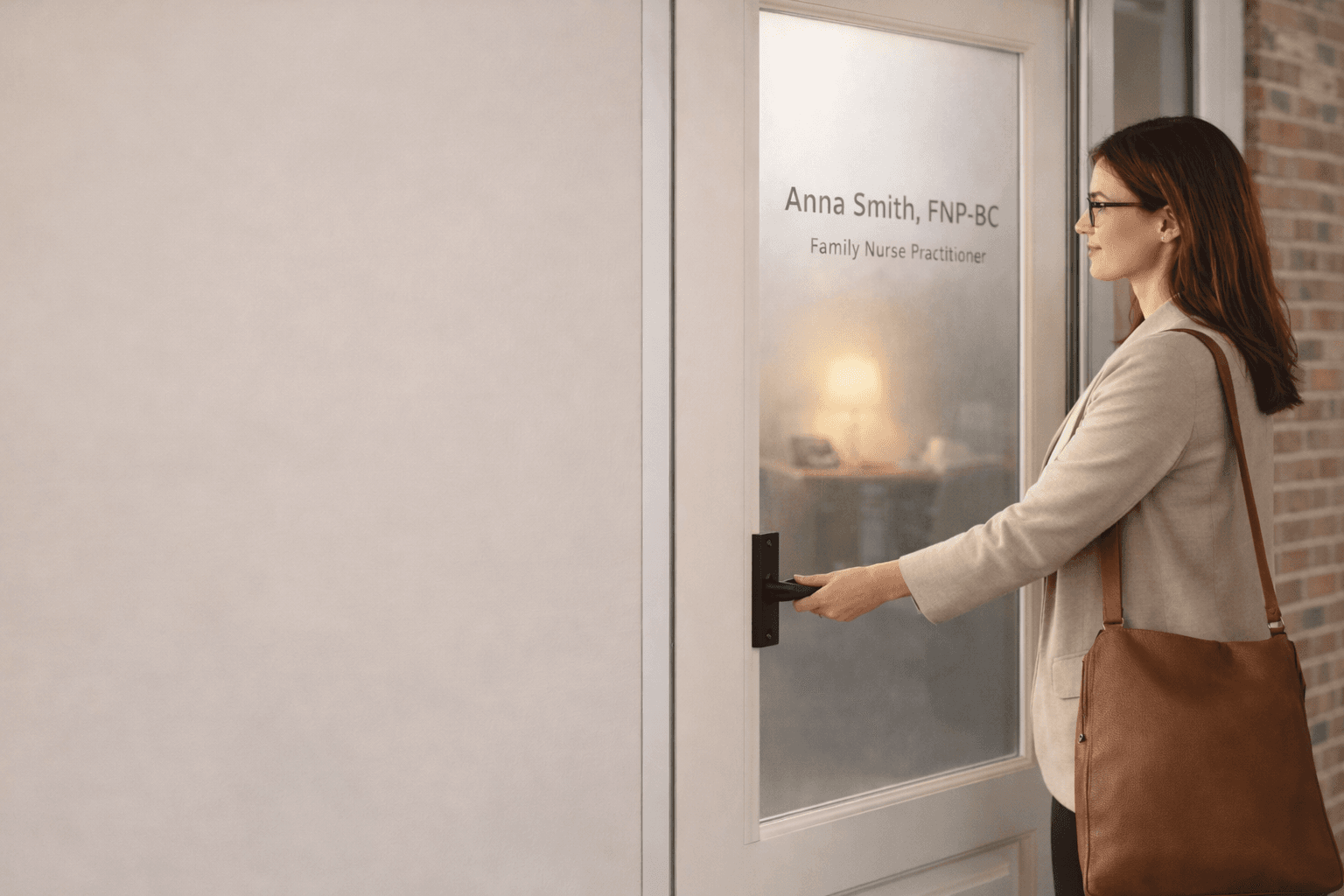
A primary care nurse practitioner in Massachusetts can own an independent practice outright. The state granted full practice authority in 2021, so after a two-year supervised-practice period you practice without a supervising physician. A four-day week works out to a ballpark $200,000 a year in practice earnings, with a panel that has a mix of Medicare, Medicaid, and commercial patients.
Because the state is losing primary care faster than it can replace it. New patients in Boston wait an average of 40 days for an appointment, about a third of residents report trouble getting primary care at all, and physicians are leaving the field at the highest rate on record. Every one of those patients is looking for a practice that has room for them — and nurse practitioners already have full practice authority here to open one.
40 days
Average wait for a new-patient primary care appointment in Boston — twice as long as the average of 15 other cities studied.
Massachusetts Health Policy Commission, 2025About 1 in 3
Massachusetts residents reported difficulty getting primary care in the past year — and wait times are still getting worse.
Center for Health Information and Analysis, 20255.5%
Share of Massachusetts primary care physicians who exited primary care — the highest on record.
MA Health Quality Partners Primary Care Dashboard, 2026There is no single "primary care practice." The demand is broad enough that you can build the one you actually want to run. These are all adult panels, and each one fills a different way. Once you've picked one, naming it is the next real decision.

Working-age adults on one panel — annual physicals, chronic conditions managed properly, and the acute visits that would otherwise be an urgent-care trip. The broadest demand of any panel, and it largely fills on its own.
A Medicare-age panel built around chronic-disease management and annual wellness visits. Grows through relationships with facilities, senior housing, and community organizations.
Well-woman care and primary care in one place, instead of two appointments with two practices. The convenience is the draw, and word of mouth does the rest.
Diabetes, hypertension, and weight for the patients who need forty minutes and keep getting fifteen. Rewards clinicians who invest in obesity-medicine and cardiometabolic competency.
Genuinely underserved across the state. A focused, affirming practice quickly becomes the place patients and other clinicians send people to.
Massachusetts has large Portuguese-, Spanish-, Haitian Creole-, and Vietnamese-speaking communities with few primary care options in their own language. In-language care fills a panel fast.
Yes. Since January 1, 2021 Massachusetts nurse practitioners have had full practice authority, so once you have met the supervised-practice requirement you can own and run a practice without a supervising physician.
Full practice authority took effect under Chapter 260 of the Acts of 2020 and 244 CMR 4.00. The path there is a minimum of two years of supervised practice — supervised by a physician or by an NP who already holds full authority — after which you file an attestation with the Massachusetts Board of Registration in Nursing and practice on your own.
Two years and no hour count is a real contrast with Connecticut's three years and 2,000 hours, and the two states are often conflated. The one piece people miss is prescribing: practicing independently means amending your Massachusetts Controlled Substances Registration (MCSR), which can take up to 30 days — worth starting early.
Read the full step-by-step guideNo supervising physician once you've completed the transition period. You own the practice and the clinical decisions.
The transition-to-practice requirement is time-based, not hours-based — a genuine difference from Connecticut.
Amend your MCSR to prescribe controlled substances independently. Budget up to 30 days for it.
Almost nobody quits on a Friday and opens a full-time practice on Monday. Here are the three routes NPs actually take. Whichever route you pick, the startup costs are the same.
| Alongside your job | Solo, full time | With a colleague | |
|---|---|---|---|
| What it looks like | Evenings and a Saturday while your salary keeps coming in. | A full clinical week from the day you launch. | Two NPs, one entity, shared overhead and cross-coverage. |
| Income risk | Lowest | Highest during credentialing | Shared |
| Time to a full panel | 9–18 months | 4–8 months | 4–8 months |
| Watch out for | Non-compete and moonlighting clauses; primary care patients expect continuity, which is hard to deliver part-time. | The credentialing gap — no revenue until payers clear you. Plan a runway. | Get the operating agreement right before you need it, not after. |
| Best if | You want to prove it to yourself before you leap. | You're past the two years and ready to commit. | You already know who you'd do it with. |
Continuity is the catch: a primary care panel expects to reach the same clinician over time, which is hard to deliver a few evenings a week. It's doable — just go in knowing it. Our guide to the first 90 days walks through the stretch between signing and your first patient, and everything it takes to run the practice covers what comes after.

“People really needed a little bit more time, more care — which was lacking in the current infrastructure.”
Anthony Rodriguez, FNP-BC · Stellar NP · Malden, MA
Read Anthony Rodriguez’s storyWe anchor the estimate to public Medicare rates, because they sit in the middle: Medicaid generally pays less, commercial plans generally pay more. Here is roughly what Medicare pays across Massachusetts in 2026 for the two visit types that make up most of a primary care panel — before the 85% that nurse practitioners bill under their own NPI.
| Typical 2026 Medicare payment | Massachusetts |
|---|---|
| New patient, level 4 (99204) | about $189 |
| Established patient, level 4 (99214) | about $145 |
Approximate physician fee-schedule amounts, averaged across the state’s Medicare localities. Nurse practitioners bill under their own NPI at 85% of them — which the estimates below already account for.
Massachusetts
about $200,000
estimated annual practice earnings · 4-day week
A ballpark for a panel mixing Medicare, Medicaid, and commercial patients — before tax, benefits, and office rent.
Translate that into a year of practice and a full four-day week lands in the neighborhood of $200,000, with a panel that has a mix of Medicare, Medicaid, and commercial patients. Round numbers on purpose — this is a ballpark, not a quote. For how that compares to a salaried role, see what independent NPs actually earn.
| Ballpark annual earnings | Massachusetts |
|---|---|
| 3-day week (30 visits/week) | about $150,000 |
| 4-day week (40 visits/week) | about $200,000 |
| 5-day week (50 visits/week) | about $250,000 |
We’ve built a repeatable system to get your practice credentialed, compliant, and growing faster than you could do it alone.
We help you create a practice identity that’s distinctly yours — your name, your specialty, your positioning. A real clinic with your vision at the center.
We handle all credentialing and payer enrollment on your behalf — CAQH, state licensing, insurance contracts. The painful part, done for you.
Your EHR, scheduling, billing, and growth playbook are ready before your first appointment. You focus entirely on clinical care. We handle the rest.
Yes. Massachusetts granted nurse practitioners full practice authority effective January 1, 2021. After completing two years of supervised practice and filing an attestation with the Board of Registration in Nursing, an NP can own and operate an independent practice with no supervising physician.
A primary care NP working a four-day week is in the ballpark of $200,000 a year, with a panel that has a mix of Medicare, Medicaid, and commercial patients. A three-day week is roughly $150,000; a five-day week roughly $250,000. These are practice earnings before tax, benefits, and office rent. The estimate is anchored to public Medicare rates, which sit between what Medicaid and commercial plans pay.
Not once you've completed the transition period. Massachusetts requires two years of supervised practice — supervised by a physician or by an NP who already holds full practice authority — before you attest to the Board and practice independently. There is no hour count, unlike Connecticut's 2,000-hour requirement.
A Professional Limited Liability Company (PLLC) — a standard LLC is not sufficient for a clinical practice in Massachusetts. You file a Certificate of Organization with the Secretary of the Commonwealth; all-in setup runs roughly $750. A professional corporation (PC) also works but is more complex.
With Kinstead handling entity formation, credentialing, and payer enrollment in parallel, most practices go from signed to seeing patients in under 90 days. The gating item is usually payer credentialing, which runs roughly two to six months per commercial payer — which is why we start it on day one.
No. They are ballpark estimates, not a guarantee or an offer. They are anchored to 2026 Medicare rates averaged across Massachusetts, with nurse practitioners billing at 85% of the physician fee schedule, across a set number of visits per week over 48 weeks — before tax, benefits, and office rent. Your actual results depend on your payer mix, panel size, and how you run the practice.
The practice you've imagined is closer than you think.
Every figure on this page is a ballpark, rounded to the nearest $5,000, for a panel with a mix of Medicare, Medicaid, and commercial patients. We anchor the arithmetic to public 2026 Medicare rates because they sit between the two: Medicaid generally pays less, commercial plans generally pay more. Nurse practitioners bill under their own NPI at 85% of the physician fee schedule, across a set number of visits per week over 48 weeks a year.
Every figure assumes a mix of 20% new-patient level-4 visits (99204) and 80% established-patient level-4 visits (99214). Medicare payments come from the 2026 physician fee schedule: each code's relative value units, adjusted by the Massachusetts geographic indices, times the 2026 conversion factor of $33.4009. Massachusetts has more than one Medicare payment locality — Greater Boston pays somewhat more than the rest of the state — and we average them into a single statewide figure rather than publish a locality-by-locality table. The annual figures are estimates of practice earnings before tax, benefits, and office rent. With Kinstead you're paid per visit, so what you take home doesn't swing with what a given payer decides to pay or how quickly they pay it.
These are estimates, not a guarantee, an offer, or legal, tax, or financial advice. Individual results vary with payer mix, panel size, no-show rate, and how the practice is run.